Meridian, ID

Lewis & Clark Middle School

Run Time: 65:59 + 2:30 kick

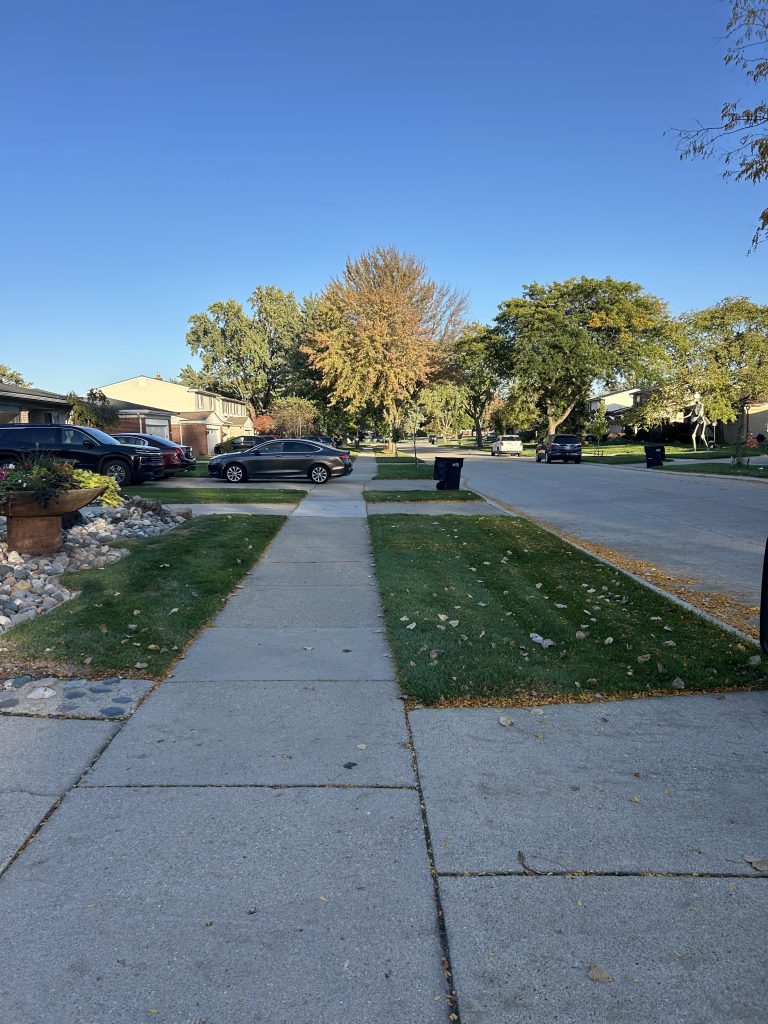
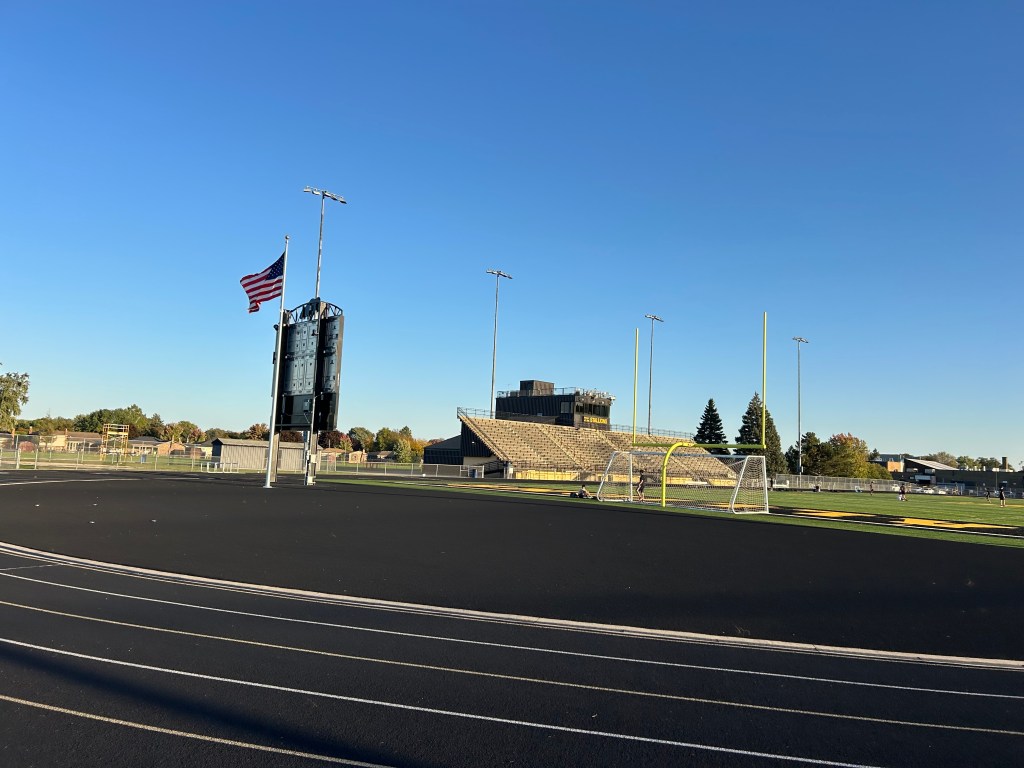
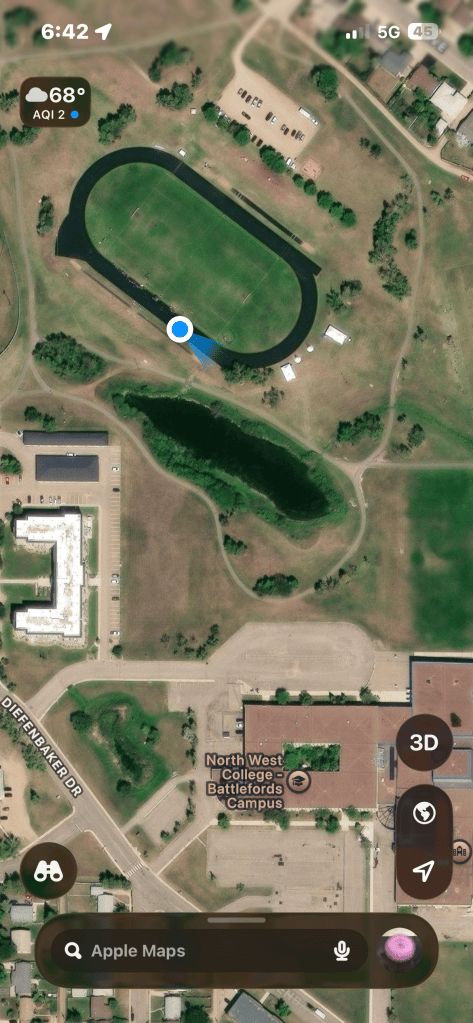
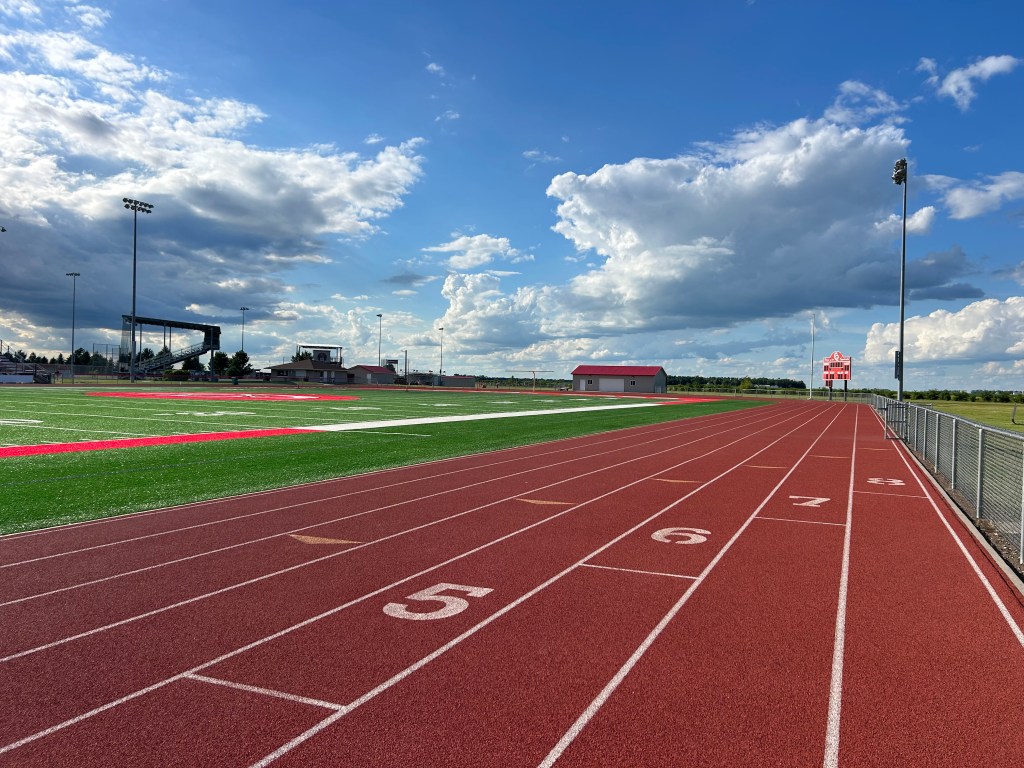
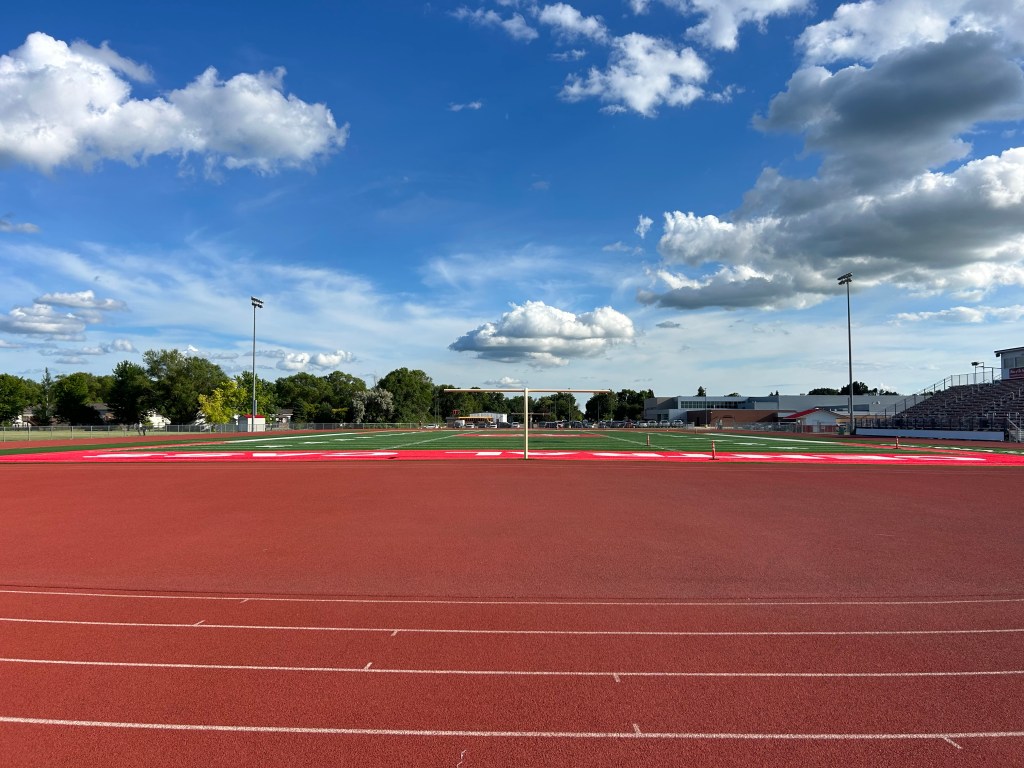
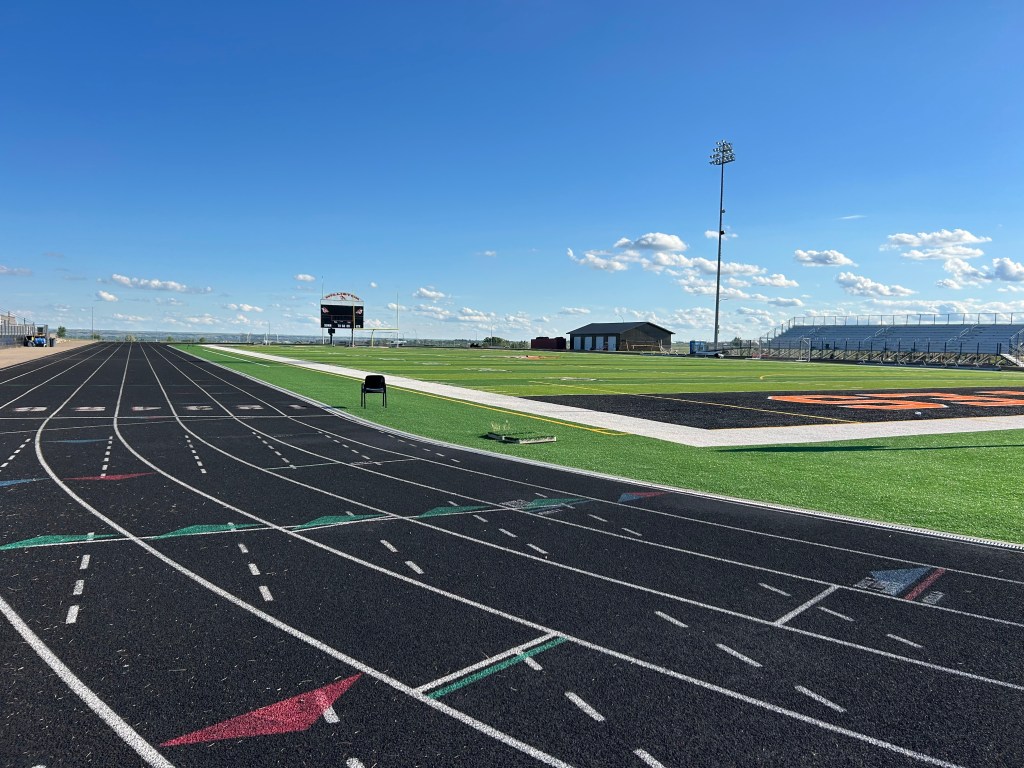
I passed this middle school about half-mile from the hotel, and I could see the empty track, so that took the research out of it, which is sometimes half the work for me. It was a beautiful day, and as usual, I was starving, but I ignored my hunger, got my running shoes on, and headed out the side exit.

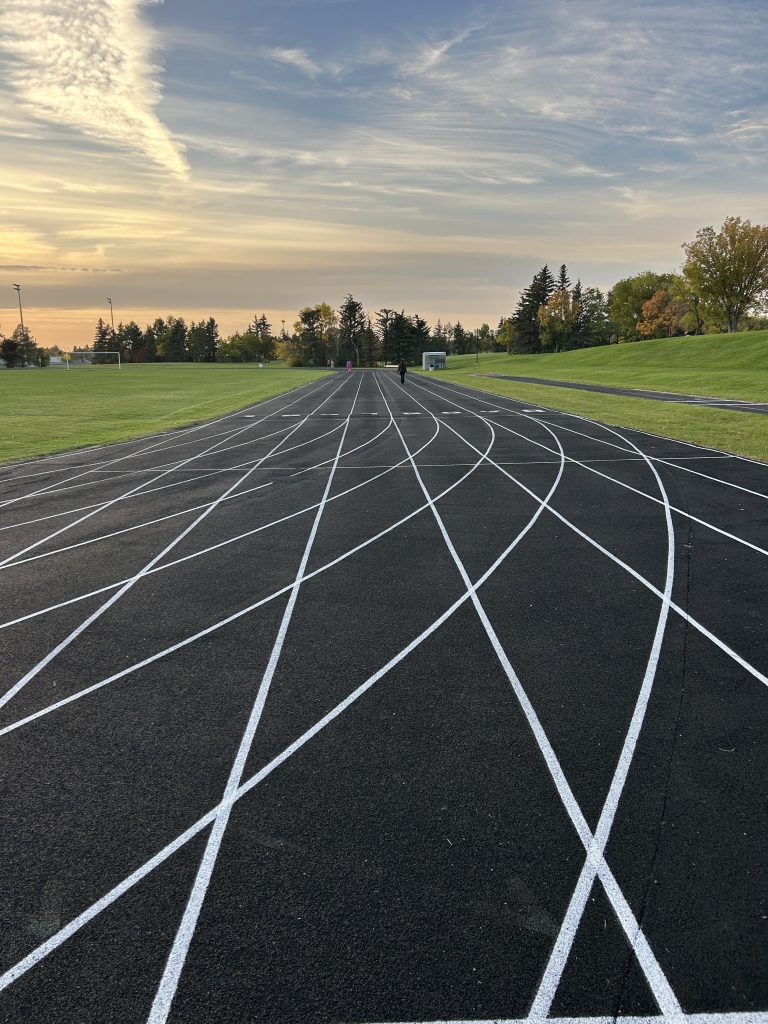
In this relatively upscale, clean suburban community, I was surprised to find a cinder track. I come across these occasionally, but usually in places like Esterhazy, Saskatchewan. Who cares, though? I’m fine with cinder. Keeps the riff-raff away.

Beings this was a middle school, and beings that my middle school had a cinder track, this took me back. I couldn’t help but reminisce about practicing baseball in and around that old track. We didn’t have a full baseball field at the middle school — just a backstop and a diamond. The track ran diagonal across right field, and it was set down a foot or so lower than the main field, so if you were chasing down a liner that was slicing foul, you’d suddenly step into air where your body thought the ground would be, and you might end up with cinder in your hair, ear, and facial skin tissue.

We played our games at the High School across town, or at the Junior High a little closer, which had two baseball fields somehow. But we practiced in that scrub grass and on that undrug diamond with no pitcher’s mound. Guess what? We won most of our games. When I see the manicured youth sports facilities that are now common all across this country, I feel so grateful for the youth sports world I grew up in, in which the only spectators were a few cute girls, and when you inherited old jerseys and equipment and turned them in at the end of the year. In ten years of playing organized youth baseball, I never had my own bat or helmet, and I was never expected to have either.

In 1978, Hillsboro, Oregon, had two junior high schools for seventh and eighth grade, a middle school for ninth and tenth, and a high school for eleventh and twelfth. The next year, they converted the Junior high schools to seventh, eighth, and ninth grades, and they made the middle school one of the Junior high schools. The high school then had tenth, eleventh, and twelfth grades. It was overcrowded, however, so the Seniors went from 7 am to Noon, the Juniors from 9 am to 3 pm, and the Sophomores from Noon to 6 pm. No full lunches — just a 20 minute snack break. Two years after that, a new high school opened, and I was in the first graduating class of 1982.

That old middle school with the cinder track, however, was my favorite. It had character. It was originally a high school that opened in 1911 or something like that. It was two stories, with high ceilings in the classrooms. The cafeteria was in the basement. The auditorium had ornate trimmings and solid, comfortable seats — it felt like a classic theater. Under the annex, which was built just after World War II, there was a bomb/fallout shelter. By the time I got there, it had been converted to a shooting range. A SHOOTING RANGE. Every year, the ninth graders had a four-week hunter’s safety course, followed by five weeks of shooting at targets with single shot .22 rifles. One guy shot an electric box that was in his line of vision and knocked out all the lights in the shelter. Fun times.

I had taken hunter’s safety and started shooting a bolt-action .243 when I was 11, so I was ready for all of this. For one of my presentations in Speech class, I explained how to gut and field-dress a deer. For another, I brought my rifle to school to show everyone how it worked. I BROUGHT MY RIFLE TO SCHOOL. I brought it on the bus, checked it in at the front office, left class to get it when it was my turn to give my speech, brought it back to the front office when I was done, and took it with me on the bus ride home. When I was walking down the empty hallway with my rifle between the front office and the classroom, a teacher came around the corner toward me and crouched down, clowning around, like he was afraid I would shoot him. He popped back up, and we both laughed. It’s not funny, I know. It was then. It was inconceivable that anyone would ever bring a weapon to a school to shoot someone.

I guess I miss more than that old school and cinder track.

Charles City, IA

Charly Weston Bike Trail/Charles City High School

Run Time: 65:54 + 2:30 kick

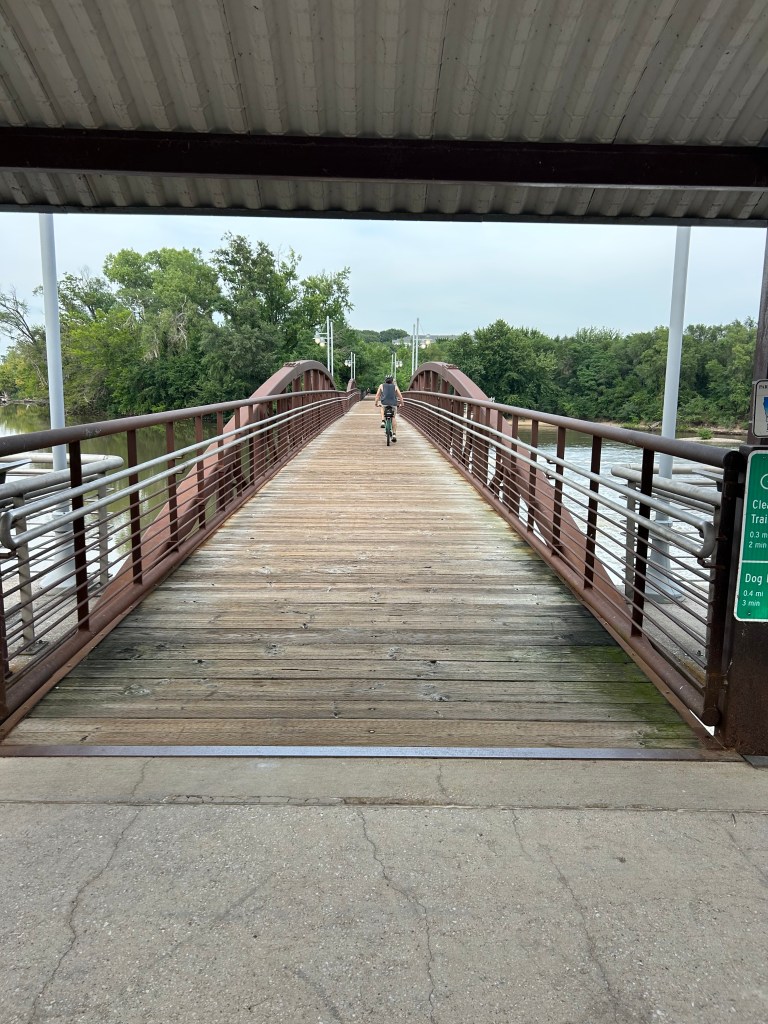
More serendipity. I saw the bike trail on my way through town to the hotel, and then it crossed the main drive only a quarter-mile or so away from the hotel. It crossed a bridge, wound through a patch of forest, and then came up right alongside the high school track. I had not been sure I had enough trail to cover half of the out-and-back run, but instead I diverted onto the track and got in more than half of the run there.

Also wonderful weather. As I ran down the trail listening to my playlist, I hit an almost euphoric state, which was augmented by the songs that came up. I listen to the songs on my playlist in alphabetical order, and recently I hit the end of the list and started back up with the A’s. One song that played during that run was a minor 1970s hit called “Ariel,” by Dean Friedman.

I started putting together my playlist around 2017 by looking at the America’s Top 40 listings from 1970-1980. I looked up the lists online and added songs one at a time. If I didn’t know or remember the song, I’d listen and then add it if I liked it. If I knew I liked it, I’d just add it. I didn’t remember “Ariel,” so I listened to it, and I kind of remembered it, but it was so far in my past and such a minor hit that it felt both familiar and fresh.

It’s a catchy song, but the genius of the song is in the lyrics. Here is one example: Standing by the waterfall in Paramus Park / She was working for the friends of the BAI / She was collecting quarters in a paper cup / She was looking for change and so was I. Here’s another: I took a shower and put on my best blue jeans / I picked her up in my new VW van / She wore a peasant blouse with nothing underneath / I said “Hi,” she said “Yeah I guess I am.” It really works with the melody too, the way the lines run together without a pause. Another passage: We had a little time, we were real hungry / We went to Dairy Queen for something to eat / She had some onion rings, she had a pickle / She forgot to tell me that she didn’t eat meat. Look, I know it’s not Shakespeare, but listen to the song. You will smile, if not laugh out loud.

Now that I have started writing songs myself, I can appreciate the difficulty of finding a lyric that works with the melody and the structure of the song, conveys a meaning that you intend, and isn’t too wordy or too sparse. It’s a completely different type of writing than prose. The rules are way different. The rhymes are hard to find sometimes. I’ve only written eight songs with lyrics at this point, and with most of them, I’ve changed the lyrics many times, right up to the point that I recorded it.

A few songs later, Janis Ian’s “At Seventeen” played through the headphones. A way different feel than “Ariel.” Case in point: Remember those who win the game / Lose the love they sought to gain / In debentures of quality / And dubious integrity / Their small town eyes will gape at you / In dull surprise when payment due / Exceeds accounts received / At seventeen. Amazing. I love when long, multi-syllable words match the beat of the song and just fit so well. This is good writing. And how profound is the use of the phrase when payment due / exceeds accounts received? I mean, come on.

Al Stewart’s “Year of the Cat” contains some of my favorite lyrics. On a morning from a Bogart movie / In a country where they turn back time / You go strolling through the crowd like Peter Lorre / Contemplating a crime. He reaches for a higher voice note and emphasizes the first syllable of PETer in a way that makes you feel like you’re cresting a wave. Right after that: She comes out of the sun in a silk dress/ Running like a watercolor in the rain. Run in running is actually the last syllable of the previous measure, so that it rhymes with sun, which accentuates the flow of the song. Running like a watercolor in the rain. Again, come on. That’s beautiful.

You don’t have to be erudite to convey profound meaning in a song. A great example is the Rolling Stones “Gimme Shelter.” It’s a very heavy message, with the first two verses referencing storm and fire, each followed by a chorus of War, children, it’s just a shot away, then a break of Rape, murder, it’s just a shot away repeated three times, and then another verse about floods, followed by the War, children, it’s just a shot away chorus, and then finishes with a reversal of the chorus: I tell you love, sister, it’s just a kiss away. Inspired writing.

I could write about how rock musicians like Mick Jagger and Keith Richard wrote such beautiful songs in the midst of drug addiction, chronic self-destruction, and a nearly complete absence of self-management, but that’s a whole other blog post. Also, instrumental music can be transcendent, meditative, and elevating. For me, a well-crafted lyric is a work of art, which it is, of course. Music is art, and thank goodness we have it.

I could never begin to remember all of the song lyrics that have made all the difference for me. When they come back around on the playlist, I am awash with gratitude, appreciation, and awe.

West Des Moines, IA

Jordan Creek Parkway Trail

Run Time: 65:53 + 2:30 kick

What a beautiful, warm spring day, so beautiful that I changed my mind when I got to the hotel and opted for a run instead of a nap. Two long drives, from Sioux Falls to Omaha, then from Omaha to Des Moines, and then it turns out that West Des Moines is clean and upscale and rather green, so it inspired me to ignore fatigue and hunger. Well done, WDM! I only chose that end of town for a hotel because it kept the drive from being longer. It appears to be actually livable.

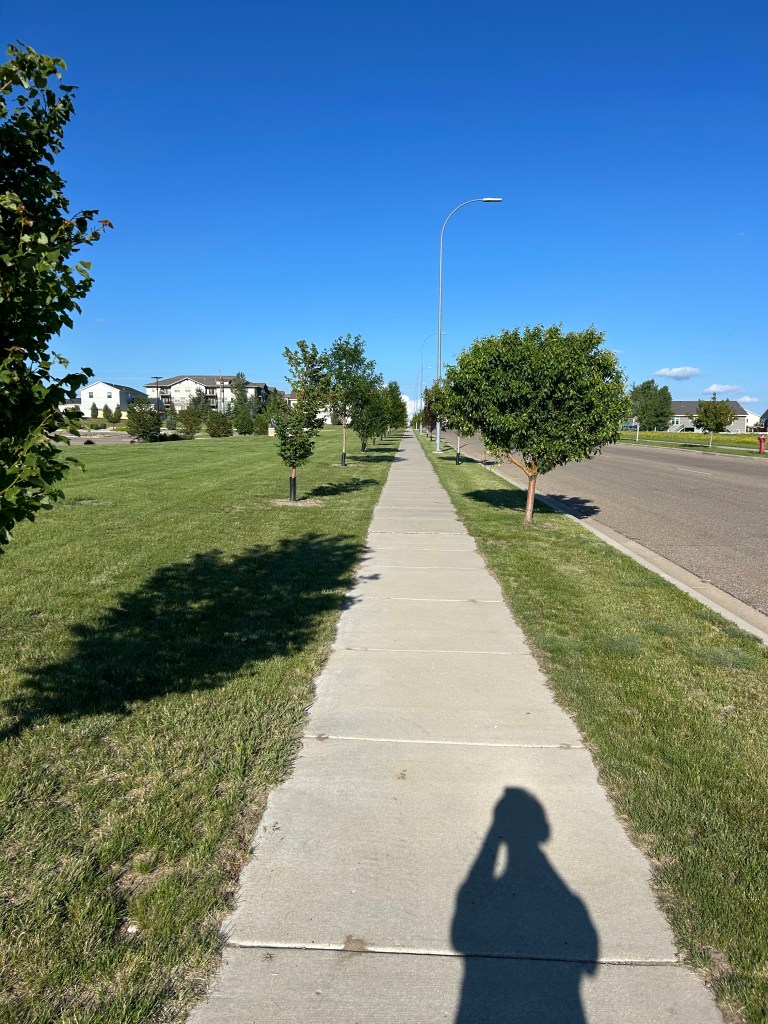
The “trail” was actually a sidewalk, but it was wide and marked with signage, and in places it diverted away from the street, and there was some grass alongside that you could run on for much of the way. A lot of friendly people walking, running, and biking. A lot of young people. Some non-white people, which was encouraging. This is Iowa, after all.

I think I wrote last time about how I started re-reading Zen and the Art of Motorcycle Maintenance as my bathroom reader. I was struck by a passage about divisions between people, written by Pirsig lo these many years ago, and how it resonates today. He uses the example of a Catholic and a Protestant differing on their opinion of birth control. My first thought was, “How quaint.” An argument between a Catholic and a Protestant about using a condom or taking birth control pills. I was raised Catholic. I remember that being a controversial social issue in the 1970s, but now it seems like such a quaint, cute little social disagreement, in comparison to the Hell that is our culture now.

Pirsig’s reference is only a one-paragraph aside, but it contains some insightful analysis: “When you’re talking birth control, what blocks it and freezes it out is that it’s not a matter of more or fewer babies being argued. That’s just on the surface. What’s underneath is a conflict of faith, of faith in empirical social planning versus faith in the authority of God as revealed by the teachings of the Catholic Church. You can prove the practicality of planned parenthood till you get tired of listening to yourself and it’s going to get you nowhere because your antagonist isn’t buying the assumption that anything socially practical is good per se. Goodness for him has other sources which he values as much as or more than social practicality.”

Your antagonist isn’t buying the assumption that anything practical is socially good per se. Wow. I’m not sure I had ever understood the religious perspective in quite that way until I re-read it a fourth or fifth time. I have long thought, as an agnostic or atheist, that we could not assume that most of humanity agrees that principles such as logic, reason, and evidence are of primary importance when most of humanity embraces belief as its foundational principle. Those two general philosophies are not compatible. Belief is not scientific. Belief does not require evidence. Belief is no logical.

Let’s think about not buying the assumption that anything socially practical is good per se. That certainly gives a religious person license to oppose something that makes sense. And let’s think about how proving practicality is going to get your nowhere with that person. That certainly explains why you can’t convince them of anything that runs contrary to what they interpret their religious teaching to be telling them. You have to de-convert them to atheism or agnosticism before you can ever hope to change their mind about something like birth control, or abortion, or vaccines, or the equality of individuals.

Maybe it’s not that dire. I am sure there are people of faith who understand and support social practicality. It’s a generalization to say otherwise, and I think generalizations are usually not helpful. I just wish the people of faith who understand and support social practicality would rise up and smite the other people of faith with some jawbones of asses.

How did humanity develop the concept of belief in a higher power? That, if anything, might be the closest thing to evidence of the actual existence of a higher power, because it makes no sense (it is NOT evidence, nonetheless). I am just imagining that, in the first several millennia of human existence, the non-believers were too busy trying to figure out how to stay alive, prosper, and propogate to take seriously and to slap around the yahoos who were praying to the stars. I can imagine them thinking, “That guy’s never gonna make it,” and they underestimated the community-building value of mass delusion. And by the time they saw what was happening, it was too late. And they probably still didn’t care, because they were too busy figuring shit out.

That’s how I feel now. It’s too late. It was too late a long time ago. Even if we got the believers down to less than 50% of the general population, the non-believers are too individualistic to take control. They’d let the believers gerrymander society into allowing them to keep control.

But… maybe we should start putting together a plan to dismantle and dissolve religious belief. What’s the formula? Anything is possible, right?

I’ll put it on my phone calendar. I’ve got 20 more years at least to work on it. Send me your thoughts (no prayers).

Sioux Falls, SD

Sioux Falls Bike Trail

Run Time: 65:52 + 2:30 kick

This was not my first run down the old Sioux Falls Bike Trail. I was here last year and stayed at the same Holiday Inn Express and made the same walk across the same strip mall to the same river bank. This time I ran east, rather than west, and I stayed in the open air and out of the trees. A glorious day for running.

I put a book on hold at the Kent County Library, and I asked for it to be moved to the branch closest to our home, and it was in transit for more than a week. I finally visited the branch to return a different book, and I explained my curiosity to the library employee, and she requested a second hold on the book, and then the next day it was available. Kind of like shooting air through a fuel line to clear it out.

So I got the book shortly before this work trip, and I am enjoying it (My name is Asher Lev, by Chaim Potok). Before that, I was reading a novel on a digital device, which is fine, but laptops and phones don’t work that well as bathroom readers. So, on my way to the bathroom one day, I grabbed my old well-worn copy of Zen and the Art of Motorcycle Maintenance off the bookshelf and read some of that over a multi-day span.

It’s been years since I’ve read it. I read it multiple times in my twenties, and loved it. Starting it now gave me an endorphin boost. It wasn’t as perfect as I remembered, but I am loving the thoughtfulness of it. By that I mean it required so much thought to write, and a fair amount to read. Yet it’s written in a plain, direct style that welcomes the reader to the inquiry.

Early in the story, the narrator announces his intention to engage in a Chautauqua with the group he is motorcycling with across the U.S.: his young son, and a friend and his wife. The kind of Chautauqua the narrator is thinking of is an exchange of ideas that elevates the nature of discourse — talking about something meaningful, rather than simply engaging in small talk. An ongoing exchange that is paused and recommenced, ostensibly until something of value is achieved. He has something in mind that he wants to communicate — I’m too early in the novel to remember what it is, and I haven’t gotten to that part yet. That his Chautauqua group includes his young son is notable — he’s treating his son as an intellectual equal.

For the narrator in the novel, a Chautauqua is a philosophical discussion, which people have all the time — they just don’t necessarily label it such. Philosophy underpins almost all human behavior. A philosophical void or vacuum inevitably means trouble. It was refreshing to read about narrator’s desire to provoke philosophical discourse with intention. But… it was fiction, after all.

In my experience, there is a serious philosophical void/vacuum in the business world. When I was a lowly tow-truck driver, drinking burnt coffee in a construction trailer under the I-405 bridge in downtown Portland, I would have philosophical discussions with my co-workers, such as whether or not humans should have the right to own property. At that time, I took the “no” stance. I’m a little more practical about it now, but if I engaged in a Chautauqua tomorrow on that subject, I’d have a hard time making the opposite case.

Like I said, it’s just my experience. Maybe at your place of work, there are deep, philosophical debates. Maybe it’s because I moved into management at some point, and I had to sacrifice most of my philosophical beliefs to get my 3% merit increase. If we wanted to get into a serious philosophical discussion, we could talk about the ethical abyss of capitalism.

Maybe capitalism was inevitable. I don’t know — seems like we could’ve come up with something better if we had had a Chautauqua.

Indianapolis, IN

Key Stadium

Run Time: 65:35 + 2:30 kick

A windy, tired day, but this track was less than a mile away. Sometimes you have to ignore everything except fortune. So glad I did. The sun made up for the wind and the coolness, and my brain woke up from the fog of driving. Indy is not my favorite city. This little pocket was unexpectedly pleasant.

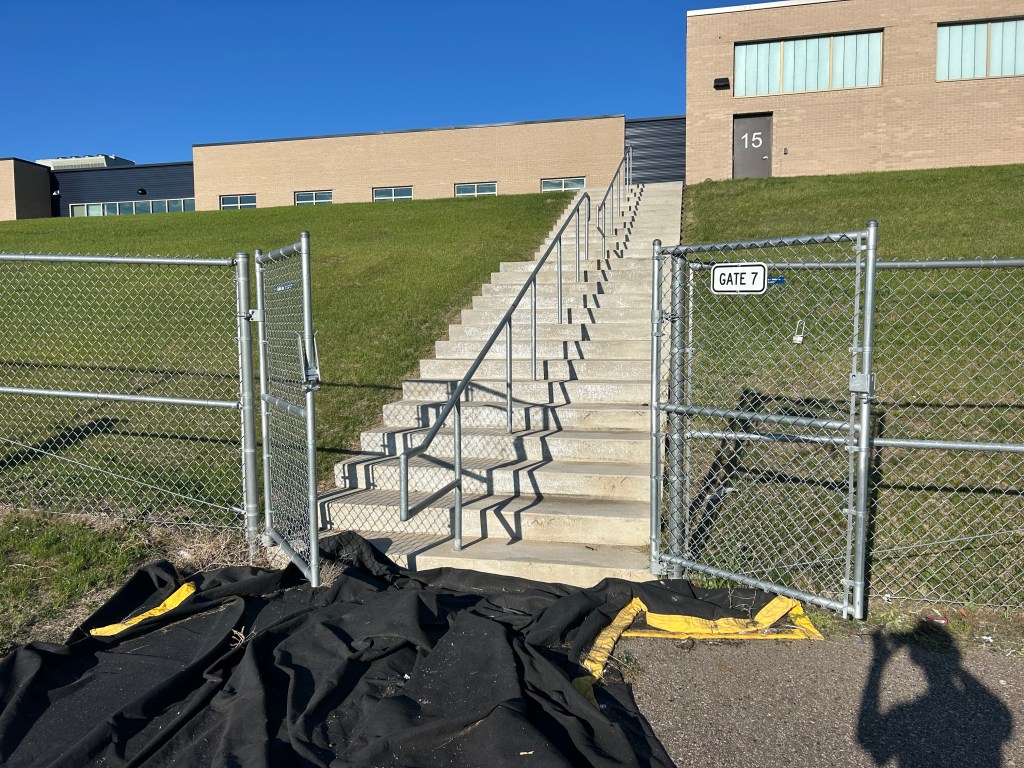
This stadium was at the University of Indianapolis, clearly a hard-scrabble, blue-collar institution. No Harvard endowment here — the track was worn through to asphalt in sections, and the grounds were not well-manicured. The bleachers were concrete, with three aisles of stairs to run. The two outer aisles were 54 steps each, the middle aisle was 47 steps, and the incline was 50.5 degrees. Brutal. By the time I got to the top of the third aisle, my thighs were burning, and my thighs don’t generally send any signals of sensation.

I’d like to think that a secondary education at the University of Indianapolis is reasonably priced, though that’s probably wishful thinking. I’d like to think that the faculty is a group of wickedly smart misfits who washed out or were cast out from more reputable institutions, the kind of mentors who sow the seeds of revolution. GOD KNOWS WE NEED THAT RIGHT NOW. What happened to higher education in this country? It used to be where radical thought originated and threatened to change society.

I’m too old, too male, and too white to lead the revolution. We need the 18-40 age group to right the fucking ship, or tip it over — whatever it takes. When some crooked politician tells a university, “We’re going to pull your funding because you are disseminating pitifully bland liberalism,” we need the students and faculty of that institution to answer, “Fine. We’re going to RIOT.” And then they need to riot.

Like everything else, the higher education game is rigged now. It’s just another financial market. And now all schoolwork is being done by AI. It’s just a system for the rich to make more money. Where is Madame DeFarge when we need her? We need a legion of Tricoteuses to inflict a new Reign of Terror on the rich and powerful.

The mascot for the University of Indianapolis is the Greyhound. That’s probably appropriate. Greyhounds have been bred for the last two centuries to race so that gamblers could bet on them. My parents used to go to the dog races. The dogs would chase a mechanical rabbit, which was later changed to a mechanical bone, possibly to appease the rabbit activists. So the Indianapolis Greyhounds are training for their chance to get on the track and chase a target that is guaranteed to stay just out of reach, so that spectators can gamble away their money on the “sport.” Not sure what exactly is the metaphor achieved here, but it’s diabolical.

Did I mention the dogs wear muzzles while they are racing? To keep them from biting each other, it was explained to me. I don’t know. They didn’t seem too interested in each other, just the rabbit (which was named Rusty, by the way). Once the mechanical device that kept Rusty moving broke, and the dogs all caught Rusty and pummeled him with their muzzles. Maybe that’s when Rusty converted to a bone. Dogs are easily trained, but I guess you need to be careful what you’re training them for.

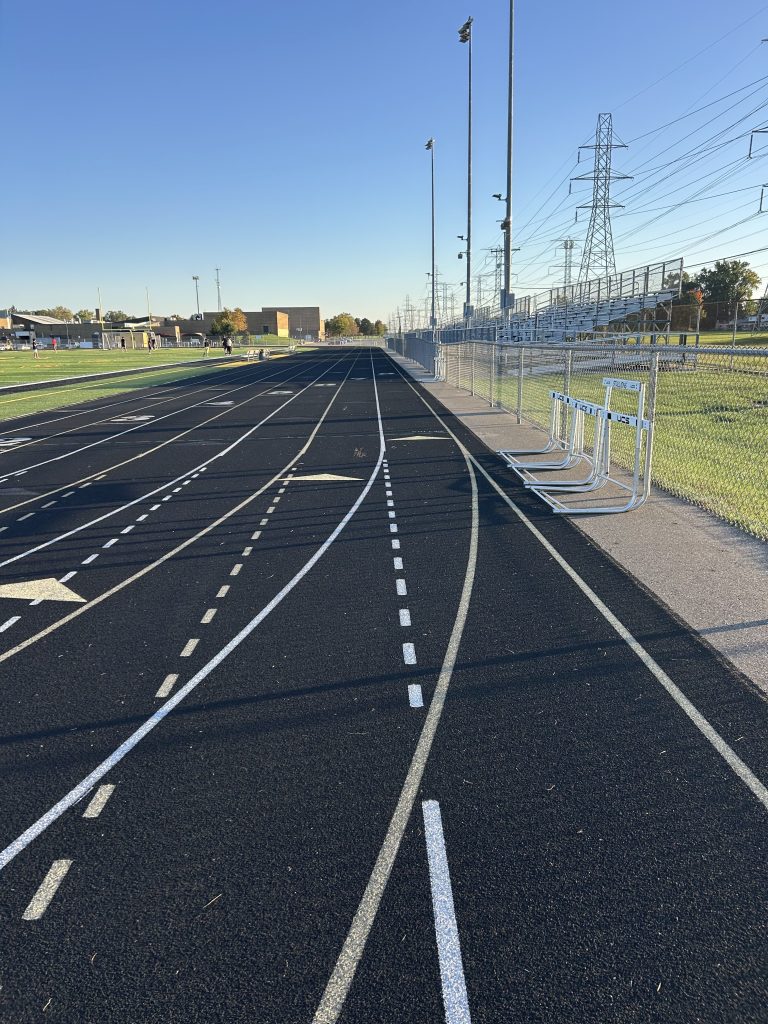
Lane 8 has an extra high hurdle hedge.

Like I said, I can’t lead the revolution. I’m too busy running in ovals, chasing Rusty. You can bet on it.

Decatur, IL

Greenfell Bike Trail

65:33 run + 2:30 kick

It was a long, cold winter. We had a temporary pause in work travel. My trip schedule for this year is smaller, so there will be fewer opportunities to run and to write. I will do my best to run as often as possible. Right now my body is sore from returning to running after a period of inactivity. It was not excited at all about driving 5.7 miles from the hotel with the loose window and wobbly toilet to run for an hour on an asphalt trail. Fortunately, excitement is not a prerequisite for this activity.

Without the travel, I fall further behind in my podcast consumption. I now assess potential unsubscriptions with regularity. Planet Money is the most recent fatality. I no longer find economics interesting. This is also going to cut back my For Later shelf at the library by 10-12 books.

Phoebe Reads a Mystery will never be cut. I’m still listening to Jane Eyre. Just found out Mr. Rochester has a hidden wife. Just finished Season 1 of Old Gods of Appalachia. Brilliant storytelling. Still working my way through the This American Life archive. I listened to five this week, the first one from September 14, 2001. Very interesting to relive what was being broadcast on NPR in the days, weeks, and months after 9/11.

One story from one of these episodes was about a European immigrant who returned to Europe immediately after World War II and interviewed Holocaust survivors. He was the first person known to have done so. The term “Holocaust” was not even in use yet. He interviewed approximately 100 people, and the recordings were housed in a university library in Chicago for four decades before someone found them and listened to them.

The interviewer spoke seven languages. The last interview he did was with a woman who described leaving her infant baby for a Catholic couple to retrieve and take to a Catholic orphanage. For some reason there could not be a direct hand-off, and since it was winter, she worried that the baby might have died before she was retrieved. The interview is in Yiddish, but the woman’s pain is transparent.

The thought of a child suffering or being harmed creates fear in me. We’ve had some extreme weather recently, and when I hear about a tornado or a flood or some other natural event beyond our control, what scares me is what happens to a child caught in something like that. Many adults cannot be trusted to protect a child in such a situation, and if even they could be trusted, the situation might overwhelm their ability to do so.

But what happened to this infant in Poland in 1939 is a world and a lifetime away, and the atrocities that happened then are beyond possibility now, right? (Spoiler alert: stay tuned, they’re not.) The difference between reading or hearing about something terrible happening to a child, and actually seeing it or being part of it is dramatic. And if the terrible thing is only implied, the difference is even greater. Can the human mind endure, every time it hears such a story, feeling anything close to the fear and anguish that woman felt when she left her infant on a doorstep in the snow, and every waking moment thereafter? We would crumble into dust if we couldn’t preserve the distance.

On March 1, the US military fired a missile into a girls school in Iran. For those responsible for the act and for this war, I wish they could feel the fear, pain, and anguish felt by every person killed, injured, or affected by the atrocity. Not only could the teachers not protect those girls (as they are so often expected to do against the worst of evils), not only could the first responders not protect those girls, not only could the parents not protect those girls, but the “leaders” of the world could not protect them. In fact, some of those “leaders” murdered them.

Did you vote for T&*#p? Their blood is on your hands as well. It was incompetence, you say? I have worked at American businesses for 45 years — I’ve seen incompetence. If it was error, there has to be another word for it. That word is not big enough to describe shipping something to the wrong address AND murdering schoolgirls.

Is there any job more important than protecting children from harm? Is anyone exempt from that responsibility? Is there anyone less deserving of life, liberty, and the pursuit of happiness than someone who would perpetrate harm to a child? No, no, and no.

Bellingham, WA

Country Roads

Run Time: 65:16 + 2:30 kick

A cool, clear night just after the time change. It was actually after sundown when I checked into the hotel across the street from the Bellingham International Airport, but it was going to be the only non-rainy day of the work trip. I had gotten up at 3:50 am Eastern to fly to Seattle, and now it was 5:00 pm Pacific, so I had been awake for 14 hours. Also, I had not run in 3+ weeks due to the Fast Pass Virus I caught at Disney World. How was the run? Invigorating.

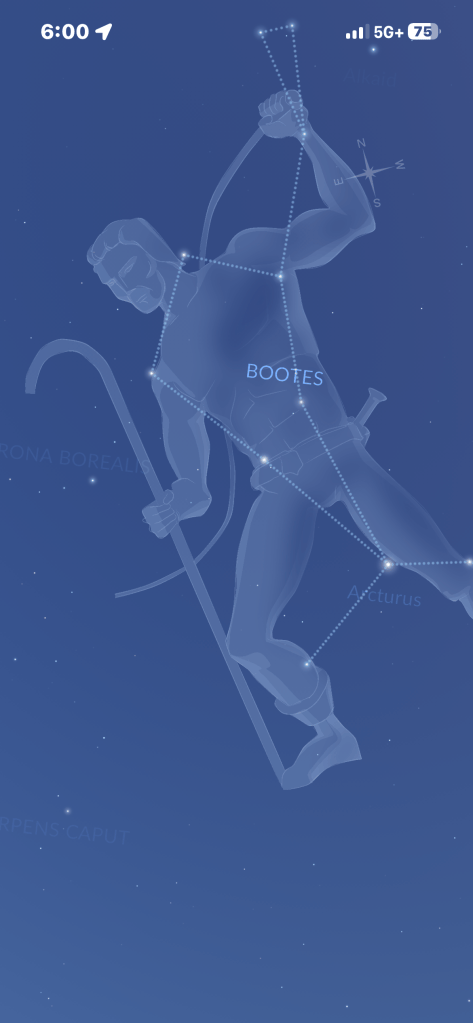
On one of the flights, I deleted YouTube from my phone. Other than Snapchat, which is only used for a family chat, I’ve completed the purge. I deleted LinkedIn last year. I deleted Twitter before it was X. I deleted FaceBook in 2018. I’ve never had Instagram or TikTok. I have nothing to look at on my phone other than my Gmail account and Family Album. I use Pocket Casts to listen to podcasts. Everything else is functional, like AllTrails, Fender Tune, Firefox, Weather, Uber, Maps, Reminders, and Sky Tonight. We have other family chats on Signal. I have nothing left to scroll.

I feel compelled to resist the attraction to the video clip. Will I miss content of value? Probably. “Miss,” in this context, means it will elude me. It doesn’t mean I will long for it. I don’t want to yuck anyone’s yum, but what if the space between activity is spent daydreaming? Or thinking? Or remembering? Or planning? I have enough writing projects to keep me writing 50+ hours a week for the rest of my life, and then some. I have enough books in my library digital For Later shelf to keep me reading for another 10+ hours a week for the rest of my life. I do neither enough. I write about 5 hours a week, and I read about 1 hour a week. How can I justify watching any YouTube video with that imbalance?
No judgment on anyone else’s choices. I do not mind if you want to watch TikTok videos or check Instagram multiple times a day. I know what life is like without all of it. That was my life for most of my life. I remember watching only what was on network TV, even before you could pop a tape into the VCR to record it. I remember long summer mornings and afternoons when there was very little on TV worth watching, when I read Nancy Drew mysteries and comic books and made forts in the blackberry bushes.

But the sidewalk is smooth and great for running.

I feel like I have been selective on social media, but there are limits to my abilities. I cannot completely filter out the meaningless, the mindless, and the ill-intentioned. I cannot filter out the marketing. When I was just out of high school and started university in 1982, I subscribed to a communist newspaper. It was a 16-page newsprint edition that came to my dorm room once a month, with in-depth articles that were way over my 18-year-old head. I recently subscribed to the DSA email list, to learn more about what they are doing, fishing around for a party I might want to join. Every email is a fundraising email. I want to know what they are about, not why they want my money.

I think I can leave it up to my family to curate the content and post what they think has value for me to check out. I enjoy reading content that is genuinely funny and/or thoughtful and/or well-written. I just feel compelled to give my attention to the long-form writing and video storytelling that requires me to make an attention investment.

How did we get to the world of YouTube and Instagram? Why is it so easy to get us to watch something or read something so short? My lovely wife reads books on her phone — a lot of them. I don’t know how many books a year she reads, but it’s a LOT. I want to commit to that practice and relearn to open a book and read a few pages when I’m waiting for someone in the cell phone lot, or when I’m eating my breakfast, or when I’m on the toilet. I’ve read the LOTR trilogy twice in the bathroom, so I know you can hit a high page count that way.

I’m not sure how I’m going to share my beer reviews and the songs I write without using YouTube, at least, and I’m going to have to figure out how to do that on my laptop. I’m sure a solution will present itself.

What will redeem us from the post and the click? I have no idea. Perhaps nothing.

Dakota Dunes, SD

The Pointe Nature Preserve

Run Time: 65:43 + 2-minute kick

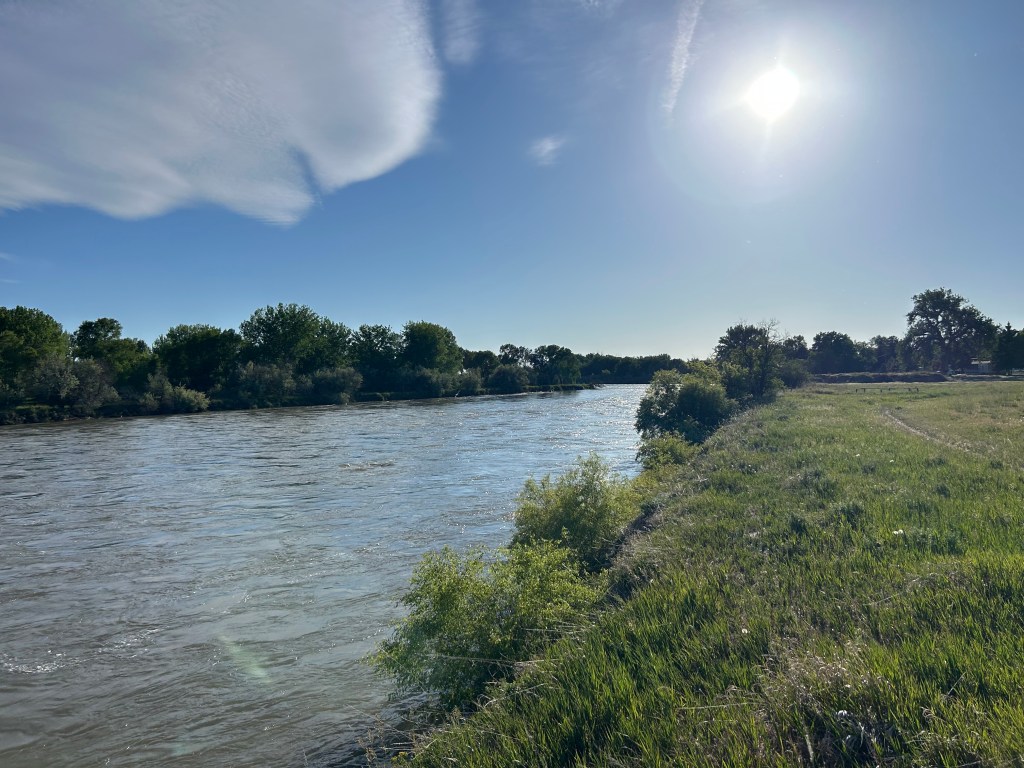
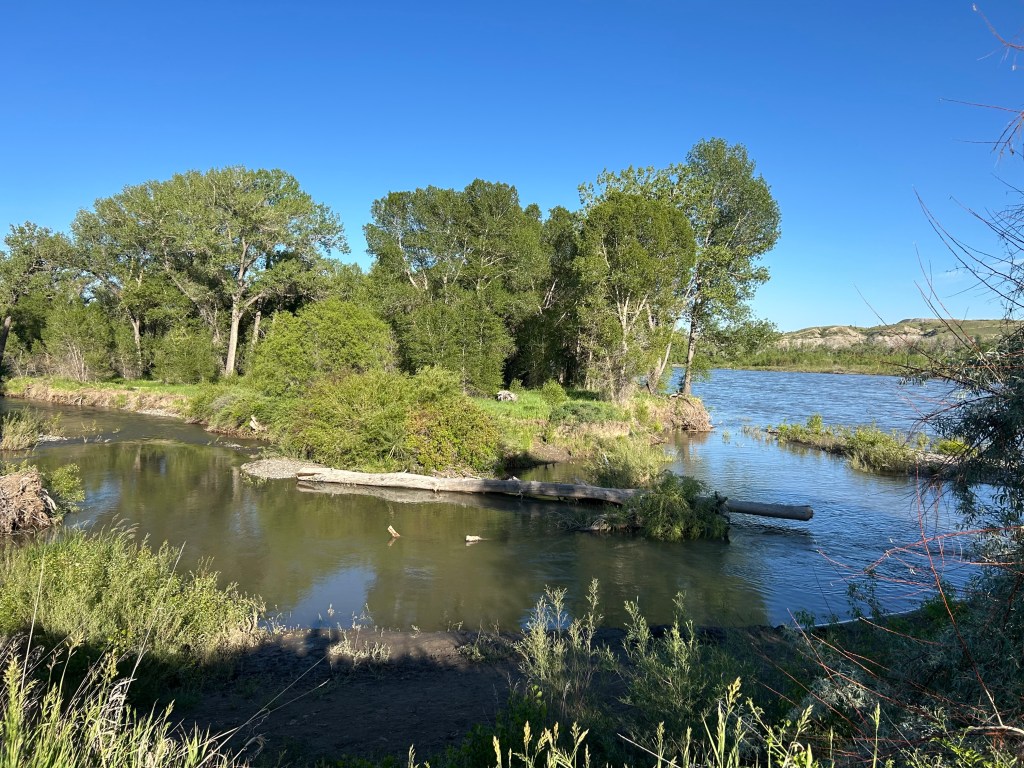
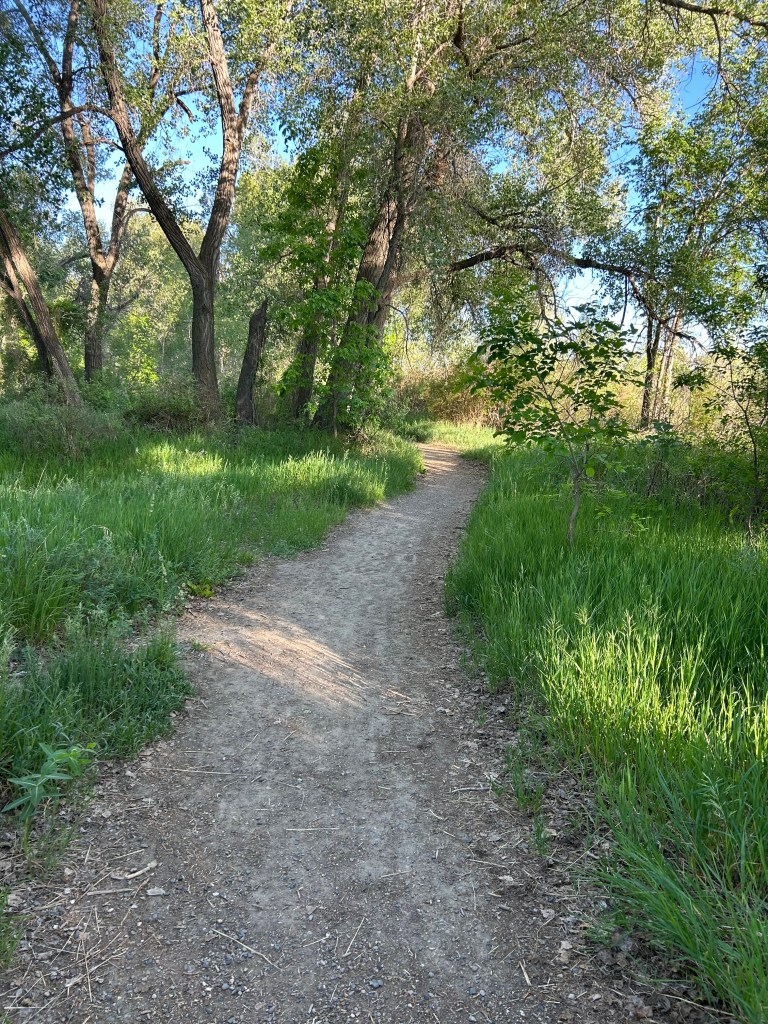
I am behind in my blogging. This run took place more than two weeks ago. I almost forgot what I wanted to write about. The run was beautiful. It was hot. Most of it was a gravel path, which took me almost to the very point where South Dakota, Nebraska, and Iowa converge, at the confluence of the Big Sioux and Missouri Rivers.

How long does it take a drop of water in the Missouri River to travel from the headwaters in Montana all the way to the Mississippi River in St. Louis? Is it possible that, in my many crossings and followings of the Missouri River, that I’ve rejoined a drop of water that I met previously?

In our family Book Club, one of the books we read this year is Learning Love, by Thais Gibson, which is about helping you to improve your relationships through the understanding and use of Integrated Attachment Theory. It’s a good book — I recommend it. Integrated Attachment Theory seems to make sense. I’m not going to try to explain it here — you’ll have to read it for yourself if you want to know more.

Some of the exercises in the book involve identifying Core Wounds — negative core beliefs “that prevent you from stepping into who you have always been destined to become” — and reprogramming them to accurate, positive core beliefs that help manifest becoming who you have always been destined to become. As you probably can imagine, Core Wounds mess with our relationships with others quite dramatically at times.

For me, identifying Core Wounds required a lot of introspection and retrospection. I had to think hard about what I believe about myself, and where those beliefs originated. It is easy, I think, to be fooled into thinking what we believe about our self is true. What other perspective do we really have besides our own? Yes, we will hear someone give us their opinion about us, and if it differs from our own, it might give us pause, but it seems reasonable to think that we would know better than anyone else who we really are and what we are really like. And we probably do. But it doesn’t mean we’re always right.

I recently listened to an interview with Patti Smith on the “Wiser Than Me” podcast with Julia Louis-Dreyfus. Julia always asks her guests if they feel comfortable telling the listener their true age, and then she asks how old they feel. Patti Smith said she has always felt like she is in the 9-11 year-old range. This resonates with me. I sometimes reflect that the voice in my head has not changed from about the age of 9, when I was in the third grade, and I started becoming confident about my independent identity.

I have my share of Core Wounds, and this book helped me to understand some of where I have been a little too hard on myself, or maybe a little too easy on myself. But it also made me wonder about the mystery of memory. Why do we remember some events so clearly, and so many others not at all? What happened to engrave something seemingly insignificant into our memory like a perfect video recording? How can we see that drop of water running through the river of our life so clearly apart from the others?

Here is a memory from when I was in the fourth grade: playing four-square on the playground at recess. In four-square, the kid serving the ball is in square 1. To their right is square 2, diagonally across from them is square 3, and to their left is square 4. There is a line of kids waiting to get into the game. When someone is eliminated by not making a proper play on the ball, the first kid in the line enters square 4, and the other three players advance accordingly.

I didn’t play a lot of four-square, but this day I did. The line was long, maybe 20 kids. As I advanced through the line, I noticed a pattern in the play. The server would make an easy bounce to the player in square 2, who would make an easy bounce to the player in square 3 that set him up to make an unplayable bounce to the player in square 4. It was a set-up to keep the 3 players in their boxes the entire recess. They were friends, of course, but it was all orchestrated by the bully in square 1. He got to keep his spot as server only through the compliance of the lackeys in square 2 and 3. Everybody in line was the victim. They basically did not even get to touch the ball.

This was unfair, obviously. I was angry watching what was happening. Kids were calling out the unfairness, but it wasn’t changing anything. I was not worried, though. In square 3 was my friend David Carr. We were not best friends, but we were good friends. He was a mellow, polite kid who was one of the “cool” kids but not a jerk. It really didn’t jibe with his personality to be the hit man who was putting all of these kids out of the four-square game unfairly. I stepped into square 4, and the same thing happened. He knocked me out with an unplayable ball. I was shocked.

I would not leave the box right away. I just stared at David. He would not look me in the eye. The dickheads in boxes 1 and 2 were yelling at me to leave, so I did. When recess was over, and we were all headed into the building, I went after David. I tackled him with the intent of pounding him. He was bigger and stronger than me, so I expected that I would be the one who got pounded. But something else happened. He saw me coming right before I got there, and he started yelling, “I’m sorry! I’m sorry!” I tackled him anyway, but he got ahold of me and just held me and kept saying he was sorry. He didn’t fight back. That was a big deal — to not fight back in front of all the other kids, for any reason, was a big deal.

A teacher came to break us apart, and David immediately began to defend me, saying it was all his fault. Everyone had seen me rush him, so everyone knew I had initiated the fight, but he wanted the teacher to know the whole story. I was still out-of-my-mind angry. I kept trying to get out of the teacher’s grip. David was the kid who got in trouble sometimes, and I was not, and I think he wanted it to stay that way. Plus, he clearly felt bad about what he had done.

Neither of us got sent to the principal’s office. I avoided four-square for awhile. I forgave David. We stayed friends all through grade school and middle school. He became a stoner, and I helped him with his schoolwork a lot. Maybe that memory stays with me because I am still unpacking it, 50 years later. Why didn’t I go after the square 1 bully? Why was I more angry at David? I saw, once I calmed down, how he had gotten himself stuck in square 3 doing someone’s dirty work, and how sad that was for him. In the course of one recess, he literally put 50+ kids out of a four-square game unfairly and felt like he had no choice. I’m sure he said that to me at one point, that he had no choice, and I tried to tell him that he did, because it was my job to tell him that, because he was my friend. I think, maybe, that I looked up to David up to that point in our friendship, and that I looked after David from that point on.

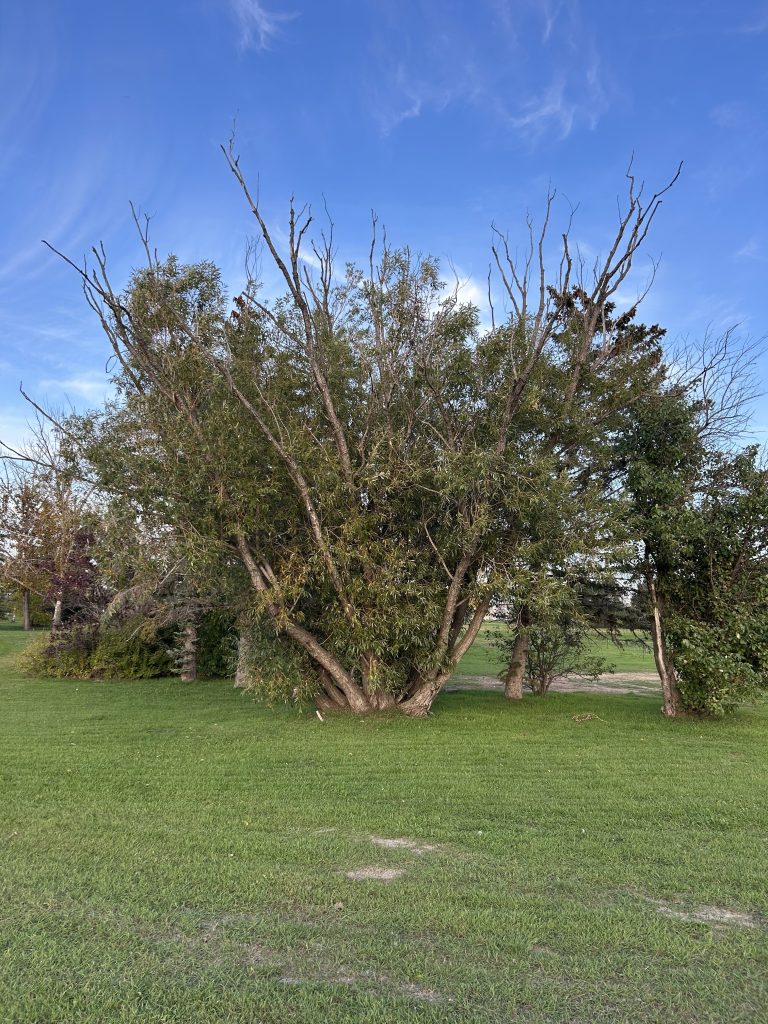
Thanks, Dakota Dunes, for leaving space for the tree.

Core Wound? Maybe. Like I said, I’m still unpacking it. There are a lot of layers to an event like this, all from a simple fourth-grade four-square game at a grade school recess. Sometimes I think we all lived an entire lifetime in our childhood. I suppose it would not qualify as a Core Wound unless I had a negative self-belief as a result that was holding me back from being my authentic self. And maybe I do. And maybe I need to reframe it now and cut myself some slack for holding David to account for the actions of others. Or maybe I need to credit myself for holding David to account for his actions and continuing to be his genuine friends. Or maybe both.

Dubuque, IA

Hampstead High School

Run Time: 65:42 + 2-minute kick

Better choices for running on the east side of Arterial drive. The Chavenelle “Trail” that I ran the last time I was here is actually the Chavenelle “Sidewalk without Shade.” This time I was able to cut through a residential neighborhood to the local high school track, where I could at least have some non-cement to run on.

It’s Youth Football Season in America, which means young middle-class athletes trying to run hard when the overweight coaches are watching, as well as parents in fold-out chairs on the sidelines and up on the path beside the tennis courts, looking at their phones. I counted 16 coaches on the field with what appeared to be 3 different teams, and 11 of the 16 were in what I would call “bad physical condition.”

What if you actually had to be in good physical shape to coach a sport? What if you had to qualify to coach a young athlete by being in good physical, mental, and emotional shape — good enough to be a role model? It might be hard to find enough candidates.

I’m not really one to talk. I was not in great physical shape when I coached youth baseball. I’m in better shape now. I probably was not in good mental or emotional shape, either, and I’m probably a little better in those two areas now as well. I think I did relatively little damage to the psyches of the young athletes I coached. Time will tell. I do get a few things thrown back at me by my youngest son, whom I coached the most, such as my coaching mantra, “Don’t be sorry. Just do it right.”

I actually think that the most qualified youth coaches are kids in college or just out of high school who played the sport in question. Most of them have not been crushed by Life and by being a parent, and they are blissfully unaware of how hard it is to teach proper athletic skills, which means it actually is not as hard for them. They tend to be relatively unbothered by the shenanigans of the parents, which basically triples their effectiveness. And they’re almost still kids themselves, so they have more fun doing it.

And, we should pay those kids to coach. Not a lot, but something, because coaching has value. In fact, whichever parent would be saved the agony of coaching themself should pony up and fund that project in gratitude. Not coaching that one season probably would add two seasons to their life span.

These kids on this afternoon were clearly not enjoying whatever they were doing. It was hot, and their hearts and minds did not appear to be into it, which made me smile as I jogged around the track. Character-building, they call it. Making your kid play a sport you wanted to be good at and fell short is a time-honored American tradition. The young athlete learns how to do not very well what someone else wants them to do.

And then, chances are, when their turn comes around to do the same thing to their kid, they probably will. If we want to break these generational cycles, we have to do something radical, such as taking men completely out of the equation. Maybe those coaches should only be women in college or just out of high school. Think of that. Think how much that would change youth sports.

Let’s make THAT happen.

Casper, WY

Casper Rail Trail

Run Time: 65:29 + 2-minute kick

I wish I could say Casper is friendly, like the ghost, but it’s rather harsh and weatherbeaten, and many of the locals appear to have partaken of the methamphetamine in the recent past. This trail ran right along a main street, and it was a short walk from the hotel, but it was borderline sketchy. Plus the red ants with an anthill every ten feet or so just off the cement, who also look like they have partaken of the methamphetamine.

It was a comfortable evening to run. Still hot, but enough clouds to keep it shady, and a mild breeze to help the sweat keep you cool. I immediately felt the elevation, about a mile above sea level. It felt great. Reminded me of running in Utah when we lived there in 2021-22. That thin air just feels great to run in, especially compared to Michigan, where we live now about 300 feet below sea level.

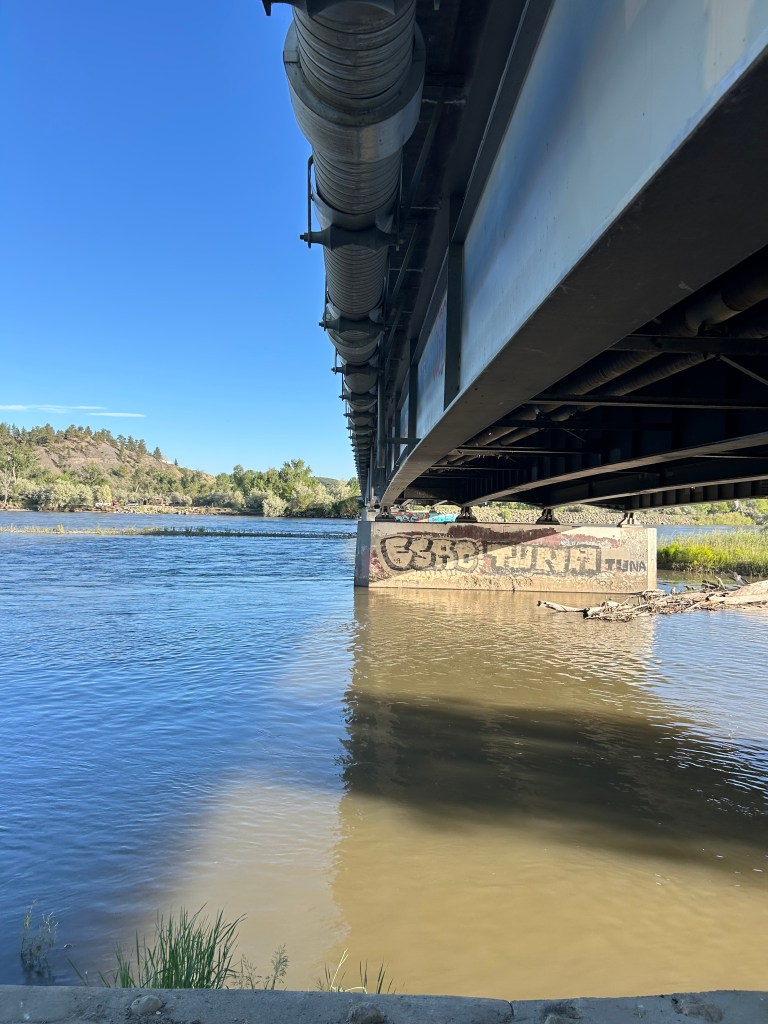
I do like Wyoming in general, especially the rural areas, and double especially the mountains and hills. I have seen hundreds of antelope this week. The antelope and the ants will inherit this land when we kill ourselves off, which is appropriate, because their existence here antedates ours. I was surprised by the level of the water in the North Platte River in Douglas. The Platte in Nebraska always looks really shallow, and if you remember your elementary school films about the wagon trains, the Platte is supposed to be a mile wide and an inch deep. It seems a little late in the year for snow melt run-off. The North Platte is upstream from the Platte. You’d think it might need some momentum to get as deep as it looks in Douglas, but it runs deeper and stronger closer to its source in the Rockies.

So, for the walking part of my “run,” I usually listen to a podcast, and then I switch to music for the running part. That’s the reward for the running. I used to listen to podcasts when I ran, and it was a slog. As soon as I switched to music, my body said yes. But, to make it say yes with an exclamation point, I listen to the podcast for walking part.

I have a complicated podcast rotation. I subscribe to 25 podcasts, and I alternate between listening to podcasts in order of episode release date, and in order of how many unlistened episodes I have in the queue. Plus, if there are 4 or more Best of Car Talks in the queue, I always start the day with the oldest of those, because they drop off the feed when I have 10 in the queue. I have a list of the next episode date for each podcast in my phone, and alongside that is how many unlistened episodes remained the last time I listened to one of those podcasts episodes, so that helps me keep track of what to listen to next.

So on this day, at the beginning of this run, I started an episode of Phoebe Reads a Mystery, which is a podcast of Phoebe Judge reading a chapter of a book (usually a mystery) every day. It’s one of the podcasts for which I have a lot in the queue — currently 592 episodes. This episode was Chapter 6 of Jane Eyre. I don’t know yet if Jane Eyre is actually a mystery, but this chapter almost made me keep it going when I switched from walking to running.

A fair portion of this chapter is a conversation between the title character and Helen Burns, a classmate at a Lowood, a school for orphan girls. Jane has recently been sent there, and she is having trouble adapting, and she has a conversation with Helen about how to conduct oneself in a difficult and dire situation. It is difficult to accept that two young schoolgirls would have such a command of the language, but of course it is Charlotte Bronte who has a command of the language, and these are fictional characters.

However, I cannot imagine that Bronte altered reality terrifically. Written dialogues usually are cleaner than real conversation. You don’t read the “ums” and “uhs” often in literature, and it’s hard to write dialogue of people talking over each other, which is usually what real conversation consists of. But I am going to choose to believe that Bronte wrote these characters accurately, and that two pre-teen orphan schoolgirls in the early nineteenth century could have a conversation more erudite, elegant, and poignant than any conversation I have ever had with any other person, even in philosophy classes I took in college. It was stunning to listen to.

The question that arose in my mind after I finished listening to Chapter 6 was, what the fuck has happened to us? Okay, so we have made great advances in terms of science and medicine and technology, but much as the headwaters of the North Platte drain to a trickle in the plains, the level of discourse for our species has shallowed immeasurably.

I have had this thought before, reading Charles Portis’ True Grit, and watching the movie 99 times. When Mattie asks LaBoeuf, “Why have you been ineffectually pursuing Chaney?”, or when LaBoeuf uses a Latin legal term, and Rooster says, “I’m struck that LaBoeuf has been shot, trampled, and nearly severed his tongue, and not only does he not cease to talk, but he spills the banks of English”, I am rendered speechless by the beauty of the language.

Human discourse now barely qualifies as communication. I not only long to talk like Jane and Helen, I long to hear someone, anyone, talk like that in the normal course of daily life. I cannot help but think we have slipped backward in this respect. I cannot help but think we would not be living in the Age of Idiocy if we had maintained this intelligent use of language.
Maybe it wouldn’t have mattered. Maybe we’d have ended up here either way. In Bronte’s time, there was terrible inhumane squalor in many parts of society, most assuredly as bad or worse than methamphetamine partaking. Squalor remains, and with respect to the use of language, an intellectual squalor predominates.
I will just have to be content listening to Bronte, reading Charles Portis, and rewatching “True Grit” for the hundredth time.