Jordan Creek Parkway Trail
Run Time: 65:53 + 2:30 kick
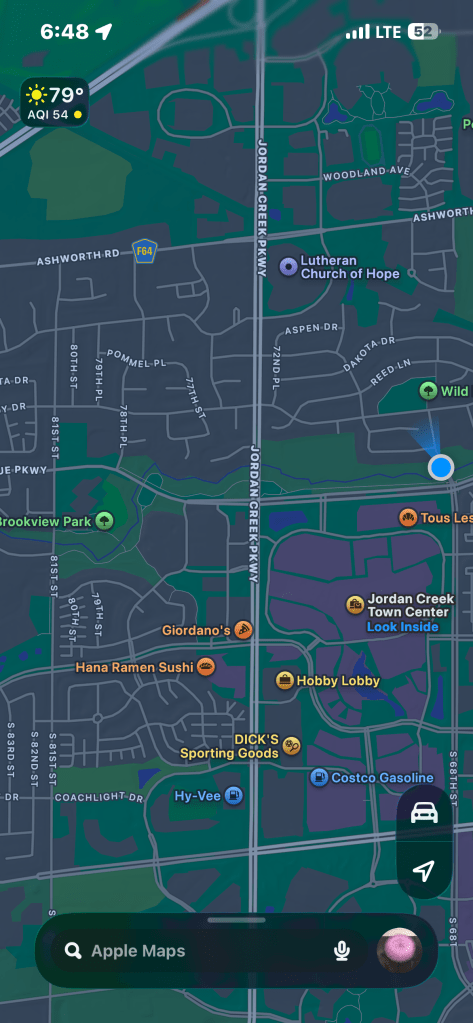
What a beautiful, warm spring day, so beautiful that I changed my mind when I got to the hotel and opted for a run instead of a nap. Two long drives, from Sioux Falls to Omaha, then from Omaha to Des Moines, and then it turns out that West Des Moines is clean and upscale and rather green, so it inspired me to ignore fatigue and hunger. Well done, WDM! I only chose that end of town for a hotel because it kept the drive from being longer. It appears to be actually livable.

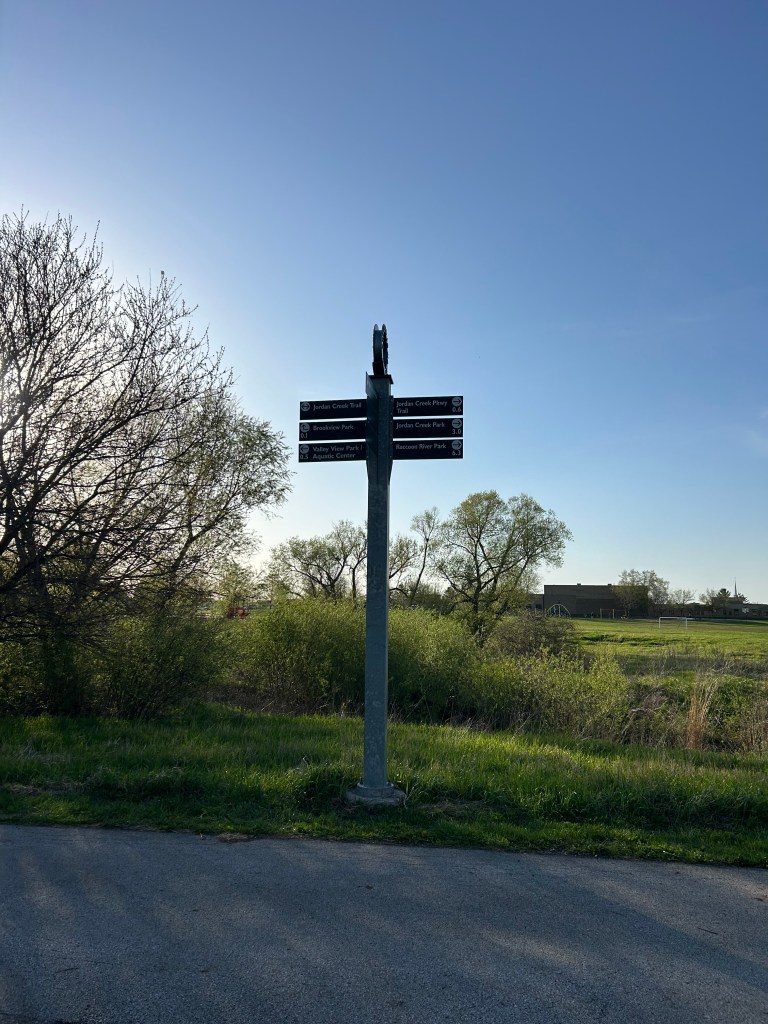
The “trail” was actually a sidewalk, but it was wide and marked with signage, and in places it diverted away from the street, and there was some grass alongside that you could run on for much of the way. A lot of friendly people walking, running, and biking. A lot of young people. Some non-white people, which was encouraging. This is Iowa, after all.
I think I wrote last time about how I started re-reading Zen and the Art of Motorcycle Maintenance as my bathroom reader. I was struck by a passage about divisions between people, written by Pirsig lo these many years ago, and how it resonates today. He uses the example of a Catholic and a Protestant differing on their opinion of birth control. My first thought was, “How quaint.” An argument between a Catholic and a Protestant about using a condom or taking birth control pills. I was raised Catholic. I remember that being a controversial social issue in the 1970s, but now it seems like such a quaint, cute little social disagreement, in comparison to the Hell that is our culture now.

Pirsig’s reference is only a one-paragraph aside, but it contains some insightful analysis: “When you’re talking birth control, what blocks it and freezes it out is that it’s not a matter of more or fewer babies being argued. That’s just on the surface. What’s underneath is a conflict of faith, of faith in empirical social planning versus faith in the authority of God as revealed by the teachings of the Catholic Church. You can prove the practicality of planned parenthood till you get tired of listening to yourself and it’s going to get you nowhere because your antagonist isn’t buying the assumption that anything socially practical is good per se. Goodness for him has other sources which he values as much as or more than social practicality.”

Your antagonist isn’t buying the assumption that anything practical is socially good per se. Wow. I’m not sure I had ever understood the religious perspective in quite that way until I re-read it a fourth or fifth time. I have long thought, as an agnostic or atheist, that we could not assume that most of humanity agrees that principles such as logic, reason, and evidence are of primary importance when most of humanity embraces belief as its foundational principle. Those two general philosophies are not compatible. Belief is not scientific. Belief does not require evidence. Belief is no logical.

Let’s think about not buying the assumption that anything socially practical is good per se. That certainly gives a religious person license to oppose something that makes sense. And let’s think about how proving practicality is going to get your nowhere with that person. That certainly explains why you can’t convince them of anything that runs contrary to what they interpret their religious teaching to be telling them. You have to de-convert them to atheism or agnosticism before you can ever hope to change their mind about something like birth control, or abortion, or vaccines, or the equality of individuals.
Maybe it’s not that dire. I am sure there are people of faith who understand and support social practicality. It’s a generalization to say otherwise, and I think generalizations are usually not helpful. I just wish the people of faith who understand and support social practicality would rise up and smite the other people of faith with some jawbones of asses.

How did humanity develop the concept of belief in a higher power? That, if anything, might be the closest thing to evidence of the actual existence of a higher power, because it makes no sense (it is NOT evidence, nonetheless). I am just imagining that, in the first several millennia of human existence, the non-believers were too busy trying to figure out how to stay alive, prosper, and propogate to take seriously and to slap around the yahoos who were praying to the stars. I can imagine them thinking, “That guy’s never gonna make it,” and they underestimated the community-building value of mass delusion. And by the time they saw what was happening, it was too late. And they probably still didn’t care, because they were too busy figuring shit out.

That’s how I feel now. It’s too late. It was too late a long time ago. Even if we got the believers down to less than 50% of the general population, the non-believers are too individualistic to take control. They’d let the believers gerrymander society into allowing them to keep control.

But… maybe we should start putting together a plan to dismantle and dissolve religious belief. What’s the formula? Anything is possible, right?

I’ll put it on my phone calendar. I’ve got 20 more years at least to work on it. Send me your thoughts (no prayers).